
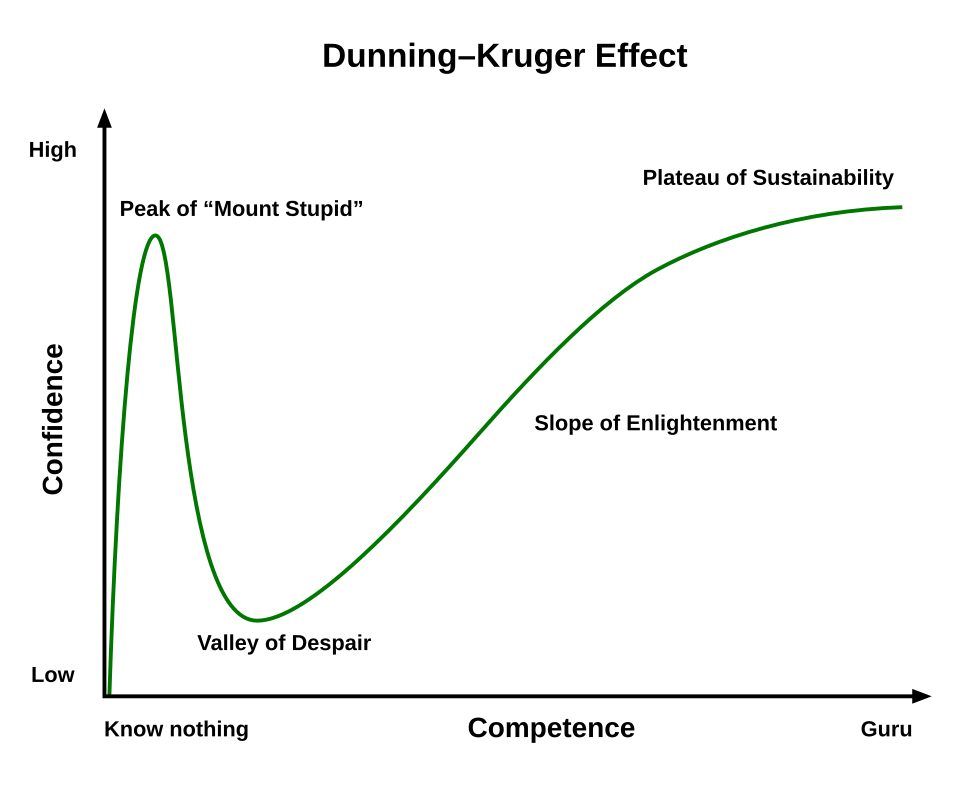
There was a time when becoming confidently wrong took some actual effort. You had to skim half a book or misread an article on the internet. I call this being confidently wrong as “Mount Stupid”.
To climb this mountain, we had to genuinely hike up. Most people gave up at base camp. So there were a few people who misunderstood things and life was good.
But those days are gone. Yeah, gone..
Mount Stupid has an elevator now. It’s air-conditioned, it even plays Billie Jeans and the doors open right onto the summit.
In case you couldn’t grab what I’m talking about, it’s the good’ol Dunning-Kruger effect.
To know more about it, read this beautiful piece of article - https://thedecisionlab.com/biases/dunning-kruger-effect
In short, you learn a little and your confidence shoots up. You learn more and you realize how much you don’t know and fall into the Valley of Despair. Then, slowly and painfully, you climb toward the actual competence.
One of the very best examples is people who play flight simulators confidently believing that they can land an airplane.
(Me, slowly raising my hand xD)
Watch this video that shred some light on this to me - https://www.youtube.com/watch?v=AbTDzPUDxqY
In software engineering, 5 years back, we tried to build softwares. We got confused, broke things. A stranger on the StackOverflow marked our questions as a duplicate of a 2011 thread.
Man it hurt.
But nowadays, with AI-assistance, software engineering looks like,
Day 1: “What’s an API?”
Day 2: Ship a SaaS
Day 3: Posts “7 lessons I learned from scaling my startup”
Day 4: Finds out the API keys were in the public repo the whole time
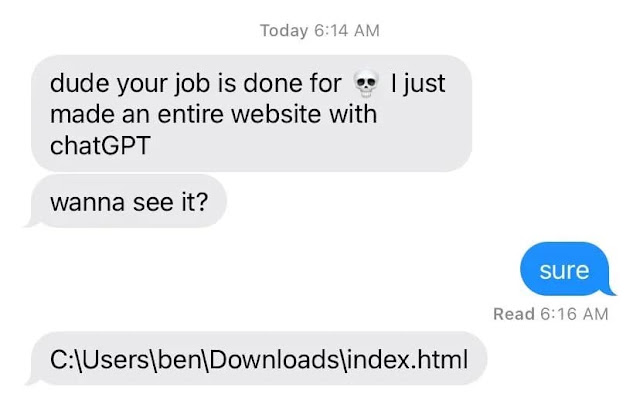
See, I’m not throwing stones here. I personally accepted a regex I didn’t understand because it came with very confident comments from a stranger in StackOverflow. But there were only a few things like regex that I might’ve not known in my application.
But nowadays, people build whole applications purely with AI-assisted IDEs.
I guess the word “AI-assisted” starts to become an understatement. The right word would be “AI-driven”.
The problem is that AI ships a huge codebase. For a person like me who hugs the computer while sleeping, I can traverse and understand that huge codebase. But for someone without or very less prior software engineering experience, the “understanding” is a big friction and it’s impossible in some cases. Without the ability to understand what’s being shipped, one can’t make sure nothing breaks.
This problem has a name, “Verification asymmetry”. AI can write code in seconds. Checking whether that answer is right takes the exact expertise you skipped.
Written code looks like a senior engineer level code, but you can’t tell whether it is one. Because telling requires being one.
The big problem I see is that it’s not that AI is sometimes wrong. Even we will be wrong sometimes.
The problem is that AI can be wrong in the same calm, polished tone it uses when it’s right. You just can’t find whether it’s right or wrong. It just feels right all the time.
Confidence used to be a rough, and lagging signal of competence. You earn it by getting things wrong and fixing them.
Nowadays, AI usage cuts that link. We skip the valley of despair.
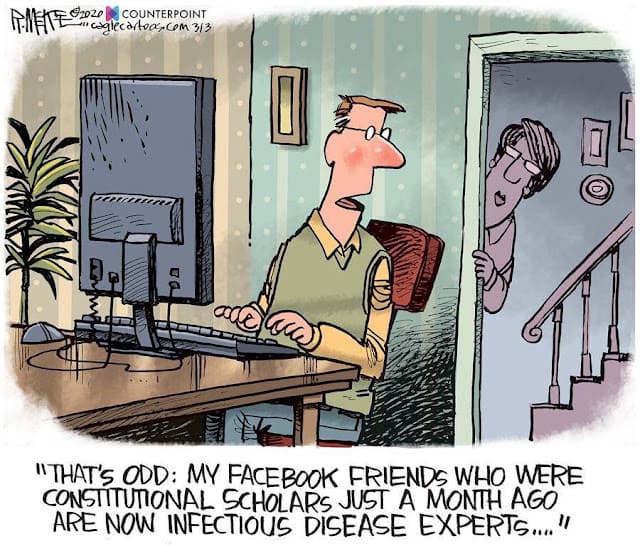
Today, you can feel like an expert without having paid any of the cost that expertise normally charges.
Alright, you might now ask me where I am getting this.
I’m not a naysayer of AI. I love AI. I use them almost daily.
It’s that letting AI carry you past the parts that are supposed to improve you.
Use AI to climb faster. Don’t use it to skip the climb. Take stairs now and then. Because that’s where the knowledge lives.
Just because Mount Stupid has an elevator that can play “Billie Jeans”, don’t get into that.
