
I know a guy who speak finished paragraphs. Let’s call him Jeff. He never reach for a word and never trail off.
When he talks, most people just nod. Most of the time he radiates negative vibe in the way he talks.
He speaks fluently. If someone asks one specific question, paragraphs will keep coming and people slowly notice that none of them is an answer.
He speaks fluently, but not right. Most of the times.
I also know few other people who are completely opposite. They get stuck. They stop in the middle and start again. But we get a feel that person knows stuff.
They just can’t really articulate well.
The problem is that we get these two people wrong all the time, and for a good reason. The fluent speech came from exactly one kind of thing called “the Mind”.
So we eventually started to treat fluency as the sign of knowledge and thought. It was really a fair bet for a very long time.
Jeff can talk perfect English than most of us. But if you converse with him for a while, you can clearly spot contradictions in his thoughts. He will start with some idea/opinion and ends with completely different one.
You might’ve met someone like that.
In this post, my goals is to tell you that LLMs are similar in nature. And I’ll try to explain what could be actual intelligence.
It’s gonna be a long ride, better grab a coffee.
[BTW]: This post is been in my draft and I’ve been fleshing out for a while. This is one of those posts where I put a lot of effort in thinking, searching and writing. With the current levels of attention span, I don’t think most of you can finish it in one go. Even if you can’t finish it in one go, pause here and there and try to finish it.
Older than machines
The bias that I mentioned above is not a new one. In fact, we have been documenting it for about 2400 years. At least, that’s how much I was able to research and collect tangible incidents.
Gorgias
In Plato’s Gorgias, Socrates refuses to call rhetoric a skill. He calls it a knack for producing conviction without knowledge.
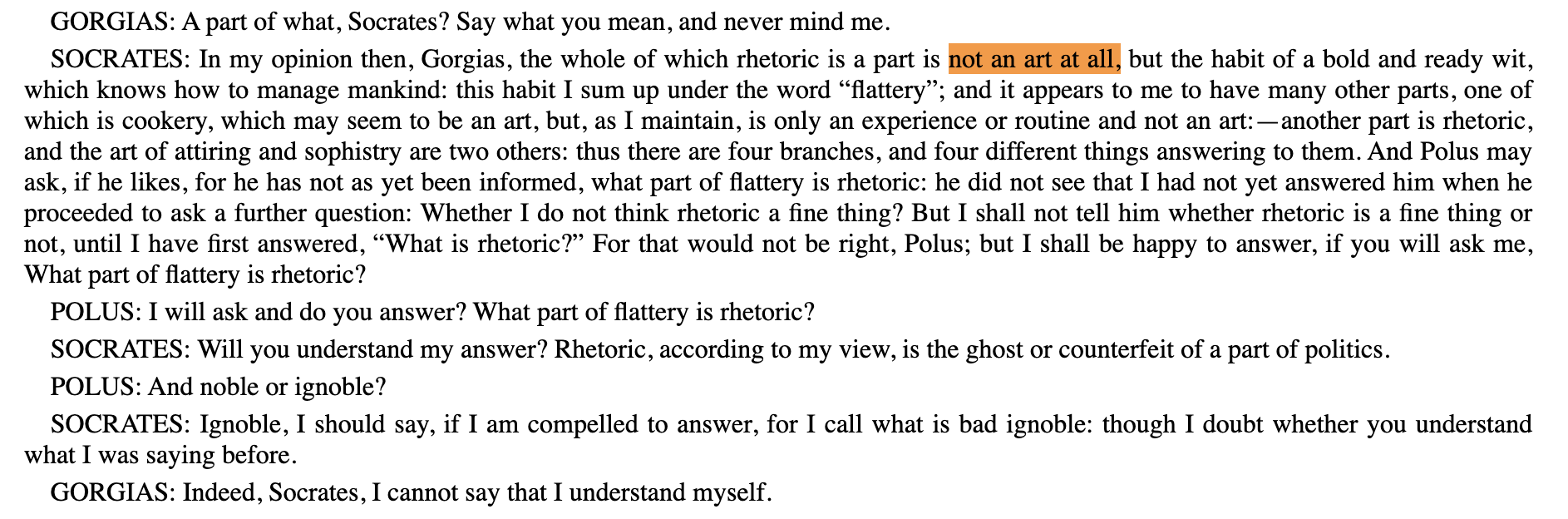
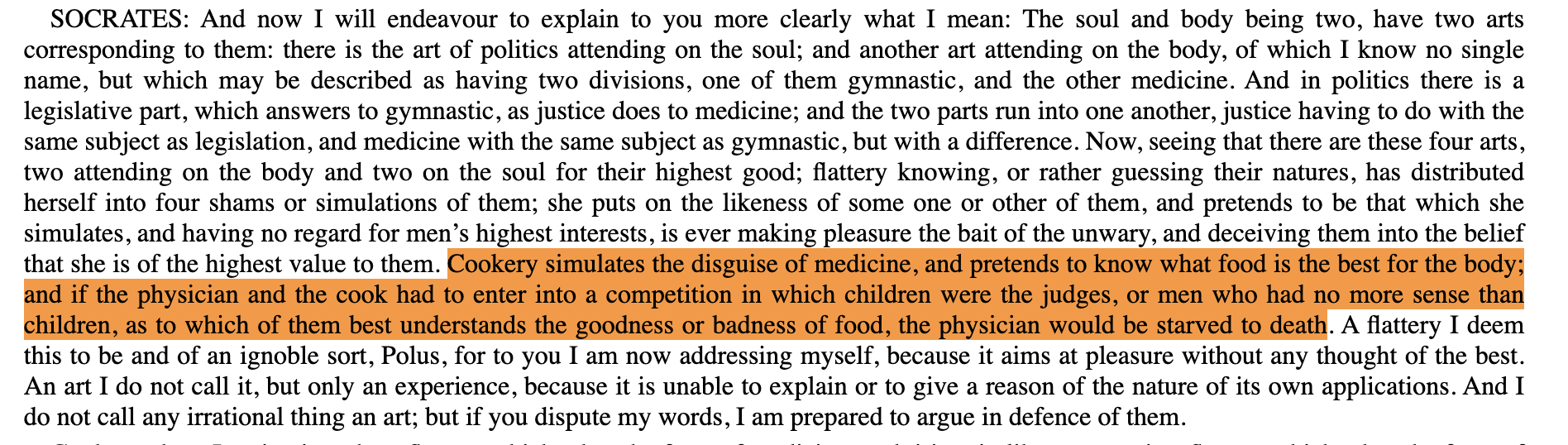
He even compares it to cookery dressed up as a medicine. He goes even further. Put a cook and a doctor in front of jury of children, he says, and ask which one understands food. The doctor will starve.
Masnavi (Please read my disclaimer below)
In Masnavi, Rumi tells a story about grammarian and boatman.
A grammarian steps into a boat and asks the boatman whether he studied grammar.
“No”, the boatman says.
“Then half your life is wasted”, says the grammarian.
(You see where this is going, huh!)
The boatman says nothing. Later the wind throws the boat into a whirlpool, and the boatman shouts across, “can you swim?”
“No.” says the grammarian.
“Then all of your life is wasted, grammarian, because this boat is going down.” says the boatman.
[Disclaimer]: I didn’t read Mansavi fully. A friend of mine shared this story and I roughly remembered. I used AI to find this book. I intended to remove this part, but my blog reviewer asked me to keep. This may not be the right material, so please do your due diligence for this part.
Lecture about nothing
In 1970, three researches hired an actor. They named him Dr. Myron L. Fox, wrote him a great CV and had him lecture on “Mathematical Game Theory as Applied to Physician Education”.
The talk was fully about invented words and contradictions. But it was delivered with warmth and jokes. Fifty-five psychiatrists, psychologists and educators evaluated him. The ratings were overwhelmingly favourable.
Watch the following skits. They pretty much resemble the guy I mentioned in the introduction,
https://www.youtube.com/watch?v=_ZBKX-6Gz6A
https://www.youtube.com/watch?v=8S0FDjFBj8o
I’m pretty sure that you won’t be bored. Don’t worry.
The horse who could count
I once talked about this with my friend. He told that he saw something like that in a YouTube short. So most of you might’ve heard about it.
Around 1900, Clever Hans, a horse, answered arithmetic questions by tapping his hoof. People were suspicious. Because of that suspicion a commission was ordered. And good enough, the commission found no trickery and announced that the horse was indeed intelligent.
In 1907, a psychologist Oskar Pfungst seemingly found out the mechanism. Apparently, the horse watched the questioner’s body tense as the taps approached the right number, then relax. So until the questioner relaxes, the horse taps his hoof. He trained himself to do exactly that.
See, no one was lying here. The horse was doing something difficult and real. But It simply wasn’t arithmetic. He arrived to the right answer via a method that had nothing to do with arithmetic, which was the everyone believed.
I recently came to know that psychologists have a name for this general effect.
The name is “Processing fluency”. Or usually called “fluency-truth effect”.
Statements that are easier to process are more likely to be judged true, even when the ease comes from the font or the contrast on the page. Smoothness feels like truth.
What the brain says
You could surely dismiss all of these as stories. But I believe that the neuroscience is harder to dismiss.
In 2024, Evelina Fedorenko, Steven Piantadosi and Edward Gibson published a perspective in Nature with a blunt title “Language is primarily a tool for communication rather than thought ”
They say that the brain imaging shows a dedicated language network that is activated when we read or listen. When the same people do arithmetic, solve puzzles or reason about what someone else is thinking, that particular network is not activated.
I heard about a condition called “Aphasia”. It is a condition where we lose almost all ability to produce or understand language. But many people can still perform arithmetic operations, play chess, follow other people’s intentions, etc., Even the words are gone, their thinking aren’t.
And very recently, almost I was about to publish post, I heard about the reverse of this. In the reverse condition, speech pours out in long, well-formed sentences with normal rhythm but carries very little meaning.
So in the one system we know is intelligent, language and thought are separate organs. The same research group named the mistake we make with machines. The “good at language, therefore good at thought” fallacy.
Language is a compression scheme
Here is how I have come to think about it. I think language as a compression scheme. The decompressor is the listener’s own model.
When I say “the glass slipped”, I only share the 3 words. The listener adds gravity, sound, shards, flinch, etc.,
None of that was in my message.
That’s why language is so efficient between human beings. And that’s also why it is such a strange thing to learn from alone.
If you know Yann LeCun, he made the same point. By his estimate, a four year old taken at least as much bytes as the LLMs were trained through vision alone. For a human to read all the text that LLMs are trained on, it will take hundreds of thousands of years. But a child who hasn’t read a word can already know that unsupported things fall.
The grammarian we built
From the title of this section, you might now get that this is the part where I am supposed to say LLMs are “just autocomplete”.
Well, I won’t!
Because, I think it is not true and I don’t believe it.
You might ask, “Hemath!!! Wasn’t that the whole point of this post?”.
Well, that’s a classic misunderstanding that many people in my circle have. I say what I see. When someone says their backend is now run by an LLM that routes request and perform tool calls, I first think if that backend can be a deterministic or not. Then I just say it that an LLM is not efficient in solving that particular problem.
And they ignore the whole context and only take the statement, “Hmm, Hemath doesn’t like to use LLM as the thinking engine in the backend. He probably must hate LLMs.”.
Some went even far and assumed that “Hemath doesn’t even like AI. He is one of those old school bloke.”
Trust me, I’m not making this up. I wish people consider things with right context. Unfortunately we are humans living with short attention span. Can’t blame!
Back to the topic, I love LLMs.
I use LLMs everyday. It helps me see things I probably miss. I helps me with writing code faster. For me it’s a fast typer with probably highest WPM record. It can explain me things at whatever levels I need.
In fact, I understood Calculus finally by talking to ChatGPT. Read this post - I finally understood Integral Calculus
It is also not a parrot. Because, researchers once trained a small GPT on nothing but a list of Othello moves. They didn’t explicitly trained it or instructed it about the Othello game. But that GPT built an internal picture of the board by itself with only the list of moves.
They could edit the board, and watch the model’s moves change to match.
So, certainly something real gets learned through pieces of texts.
And the frontier is also moving, exponentially. In July 2025, Google Deep Mind’s and OpenAI’s LLMs each solved 5 out of 6 problems at the International Math Olympiad.
If you don’t know, 5/6 is a gold-medal score!
Now you might wanna ask, “Hemath!! then what’s your problem here?”. And you’re right to be frustrated at this point.
Please be patient and continue reading.
My complaint is not with the grammarian. He is perfect and magnificent. My complaint is with the synonym.
Somewhere around 2023, the term “AI” quietly came to mean LLMs. And the rest of the field sort of became a footnote.
In my words, I’d say, “We found the mouth and started calling it the mind”.
Kepler without Newton
This is one of my favourite part.
Kepler is a genius. He was an astronomer. Through pure empirical data analysis, we was able to predict position of planets. He can tell us where Mars would be next year.
But he can’t explain how the planets move. He collected years worth of data and through empirical analysis, he can give us a predicted position which is more or less correct.
Kepler can predict, but Newton can tell why.
Because Newton invented calculus and gravitational constant. With this (and some other discoveries), Newton can not only gives us an equation, he can explain why the planets are there in the predicted position in the first place.
On the single task of predicting orbits, answers of both Kepler and Newton were almost the same.
But the difference becomes visible, only when we change the question. Instead of asking orbit of Mars, if we ask about a new planet, Newton can derive a formula and predict a position. But Kepler can’t, he needs data for the empirical prediction.
Since Newton didn’t stop with empirical analysis and went down the rabbit hole to understand why planets move the way they do, we can now predict where an thrown object will land, where rocket boosters can land. We are able to study tides. And etcetera, etcetera.
Yes, with Kepler’s we can answer a specific question, but with Newton’s we are able to understand it. And with that understanding, we can discover other things.
In 2025, Keyon Vafa and colleagues took this situation and turned that into an experiment. They trained a transformer on sequences of planetary positions until it predicted orbits accurately.
It performed well even for the solar systems it had never seen.
With this model, they then probed what it had learned by asking it some other physics task. If this model, learned physics properly, it would lean towards force-based answers.
But it didn’t. It behaved as if it had collected task-specific shortcuts that didn’t carry over.
Like Kepler and Newton, this model’s prediction was perfect and fluent. But there is no inherent understanding.
In sequel to this experiment, in 2026 very recently, Ziming Liu and colleagues showed that the same kind of model can recover Newtonian mechanics. But if we give it three simple inductive biases.
Those inductive biases are,
- Stop treating positions as discrete tokens and predict continuous numbers. Because chopping space in to vocabulary destroyed the smoothness of space.
- Add robustness to noise.
- A preference for recent context.
With these inductive biases, the model moves from Kepler to Newton.
If we read those papers, the lesson is precise and it is what we already know. Neural networks can understand. We have been building neural networks for ages and it’s proven that a well designed neural network can understand things.
But the problem comes with neural networks that does sequence prediction. Sequence prediction alone doesn’t guarantee that they can understand inherent relationships.
The solution is decided by what shape we give the problem. And the first repair was to stop pretending the world comes in tokens.
An expensive place to think
Let’s suppose a language model, with enough scale, could learn everything.
I would still question whether the words (I mean tokens, btw) are the right place to do the thinking.
An LLM can produce it’s response one token at a time. An we know each token costs a full pass through the network.
When it “reasons”, it mostly does so by writing more tokens. Basically it thinks by talking.
We do not narrate physics in order to catch a ball, do we?
An alternative is to think in a compact internal space and speak only at the end. If you’re following the AI realm, you know what I’m talking about.
Think in compact internal space and speak only at the end is the ideas behind LeCun’s JEPA.
We have VL-JEPA, V-JEPA and newly LeWorldModel.
None of these models proves that the small and quiet architectures will win. Instead they show that when you stop forcing every thought through vocabulary, things get cheaper easily.
The ones that never learned to talk
My favourite part again. As the industry was focused mostly on the chatbots, some of the most useful AI of the decade were built. Interestingly, these are built by systems/architectures that cannot write a sentence.
| System | What it does | What it showed |
|---|---|---|
| GenCast, Google DeepMind, Nature, Dec 2024 | 15-day probabilistic weather forecasts | It beat the operational ensemble ECMWF’s ENS on 97% of targets. One forecast takes just 8mins on a single chip |
| WeatherNext Cyclones, Google with the US National Hurricane Center, Nature, 2026 | Track, intensity and size of tropical cyclones | Three-day forecasts as accurate as earlier two-day ones. Helped forecasters anticipate Hurricane Melissa’s rapid intensification in 2025. |
| AlphaGenome, Google DeepMind, Nature, Jan 2026 | Reads a million letters of DNA and predicts how variants change gene regulation | Matched the best existing models in 25 of 26 variant-effect evaluations. |
| Dreamer 4, Google DeepMind, 2025 | Learns a model of Minecraft from recorded video, then practises inside its own imagination | First agent to obtain diamonds from offline data alone, with no practice in the real game. |
| Genie 3, Google DeepMind, 2025 | Generates explorable worlds from a prompt | Runs in real time at 720p and 24 frames per second, staying consistent for minutes. |
| Tiny Recursive Model, Samsung SAIL Montréal, 2025 | Solves puzzles by repeatedly revising its own answer | 7 million parameters. Scored 45% on ARC-AGI-1 and 8% on ARC-AGI-2, ahead of most language models at the time. |
| Jev | New kid on the block. System one model for decision making | Works as a zero-shot classification model to make decisions |
Include AlphaFold, whose creators shared the 2024 Nobel Prize in Chemistry, and the pattern is hard to miss.
You might think that these models are very specific and powerful, therefore they must not use LLM-related technologies.
You would be wrong. They are all deep learning models. Several of them use transformers and diffusion. Genie 3 is even autoregressive.
Yeah, they use the same toolbox as LLMs. Then what’s the difference?
I’ll tell you. The difference is that these models don’t think in terms of words/tokens. Each was shaped around the structure of its own problem.
Where I could be wrong
Well, yeah. I could be wrong. At the end of the day, también soy humano!
In fact, an argument that only quotes its friends is fluent in exactly the way this post warns about. So I take the following set of objections seriously,
- The brain is not the model
The neuroscience says language is not thought in humans. A language model is not a copy of the real language network. And it’s hidden layers may do more than that’s not linguistic. We can take Othello-GPT as an example for that.
The brain tells me that text is a narrow window. But I can’t completely say that nothing can be seen through it.
- Maybe prediction forces understanding
To predict the next word of a physics book, you would need to know physics. That is the strongest case for scale. My answer is the Kepler experiment. It can happen, it is not guaranteed, and the open question is cost.
- The models are no longer text-only
These days frontier models can take can take in images, videos and audios. And these models can even understand the contents of them. Most of them still convert everything into tokens and predict the next one. Although it’s a wider keyhole, it’s still a keyhole.
- The alternatives have not won
Yeah, it stings me. So I’ll state it plainly.
On Meta’s own intuitive-physics benchmark, IntPhys 2, most models tested scored near chance while humans were near perfect, and that includes video models. V-JEPA 2 can pick up an object and put it down. It cannot run a kitchen. The CEO of LeCun’s new lab calls it fundamental research, with commercial applications possibly years away.
What I am actually frustrated about
As I already mentioned with the grammarian analogy, it’s the monoculture that is frustrating me.
According to Stanford’s 2026 AI Index, private AI investment reached $344.7 billion in 2025. Generative AI took $170.9 billion of it, nearly half, after growing more than 200% in a year.
And if this money goes into research for the better architectures or improving infrastructure, I would be really happy.
But much of that engineering energy around that money goes into the layer above the model. I’m talking about agent frameworks, orchestration tools, protocols, etc.,
The work is useful. Yes. I use it everyday.
But notice what it is.
It is scaffolding around one organ. Every clever framework for making a language model check its own answer is, in part, a patch for something the architecture does not do natively. We are getting very good at building a body out of mouths.
If you know, re-inforcement learning has a name for this. That is “exploiting”. An agent that only exploits what already works never finds anything better. The field is exploiting.
I’m not obviously the first person to say this.
Richard Sutton wrote the essay “The Bitter Lesson”, which is quoted more often in defence of scaling LLMs.
The author of the “Tiny Recursive Model” put it more gently, “too much effort goes into exploiting language models and too little into new directions”.
That’s my whole point in single line.
Learn to swim
Let’s go back to the boat.
Although the grammarian wasn’t lucky, he wasn’t wrong about grammar. Grammar is beautiful and without it life is poorer.
His mistake was one of proportion, he looked at the one thing he had mastered and took it for half of everything.
As I mentioned, we built the greatest grammarian in history.
I’m surprised. I’m lucky. I talk to it every day and I’m grateful for it.
More importantly, I don’t want it to be thrown overboard.
But the water is still there. The water is a storm five days from a landfall. Many problems were ever going to be settled by speaking well.
I wouldn’t say, I dislike fluent people.
I love them, especially, when the fluency is sitting on top of something. The eloquent one should be the spokesperson for the team, never the whole team.
So keep the grammarian. Keep him in the boat. And could a few more of us, please, learn to swim.
Sources and references
The human side
- Plato, Gorgias 464: the cook, the doctor and the jury of boys
- Rumi, Masnavi I: 2835–2847: the grammarian and the boatman
- Dr. Fox effect: Naftulin, Ware and Donnelly, “The Doctor Fox Lecture: A Paradigm of Educational Seduction,” Journal of Medical Education 48 (1973)
- Clever Hans: Pfungst’s 1907 investigation
Language and thought
- Fedorenko, Piantadosi and Gibson, “Language is primarily a tool for communication rather than thought”, Nature, 2024
- Fedorenko and Varley, “Language and thought are not the same thing”, 2016: the aphasia evidence
- Mahowald et al., “Dissociating language and thought in large language models”, Trends in Cognitive Sciences, 2024
- NIDCD aphasia fact sheet: fluent aphasia
- Yann LeCun on the Lex Fridman Podcast: the four-year-old estimate
What sequence models do and do not learn
- Li et al., “Emergent World Representations” and Nanda et al.: Othello-GPT
- Euronews on the 2025 Olympiad results
- Liu et al., “From Kepler to Newton”, 2026
- Bordes et al., “IntPhys 2”, 2025
The JEPA family
- VL-JEPA, ICLR 2026
- V-JEPA 2, 2025
- LeWorldModel, 2026
Money and dissent
- Stanford AI Index 2026, Economy chapter
- TechCrunch on AMI Labs’ $1.03 billion round, March 2026
- Richard Sutton on the Dwarkesh Podcast, September 2025
